
#006 Lovely Things
A short post with nice pictures.

I don’t have an essay for you this month. As soon as I sat down to draft something, the topics I’d thought I might write about suddenly seemed both boring and difficult. I’m writing this Substack for your pleasure and mine, so, as a little treat for both of us, I thought I’d scan in some images from books I’ve bought over the last few months, and we can just enjoy them together.
Margot Sandeman
A friend of mine sent me a saw-this-and-thought-of-you photo of a painting by Margot Sandeman from an exhibition in Glasgow. I liked it, so I bought a sale catalogue from a 2006 exhibition. It came with a note from the seller, explaining that Margot Sandeman was a relative, and letting me know I could email for more information about her. Do you, reader, want to know anything? Perhaps I can find out for you.
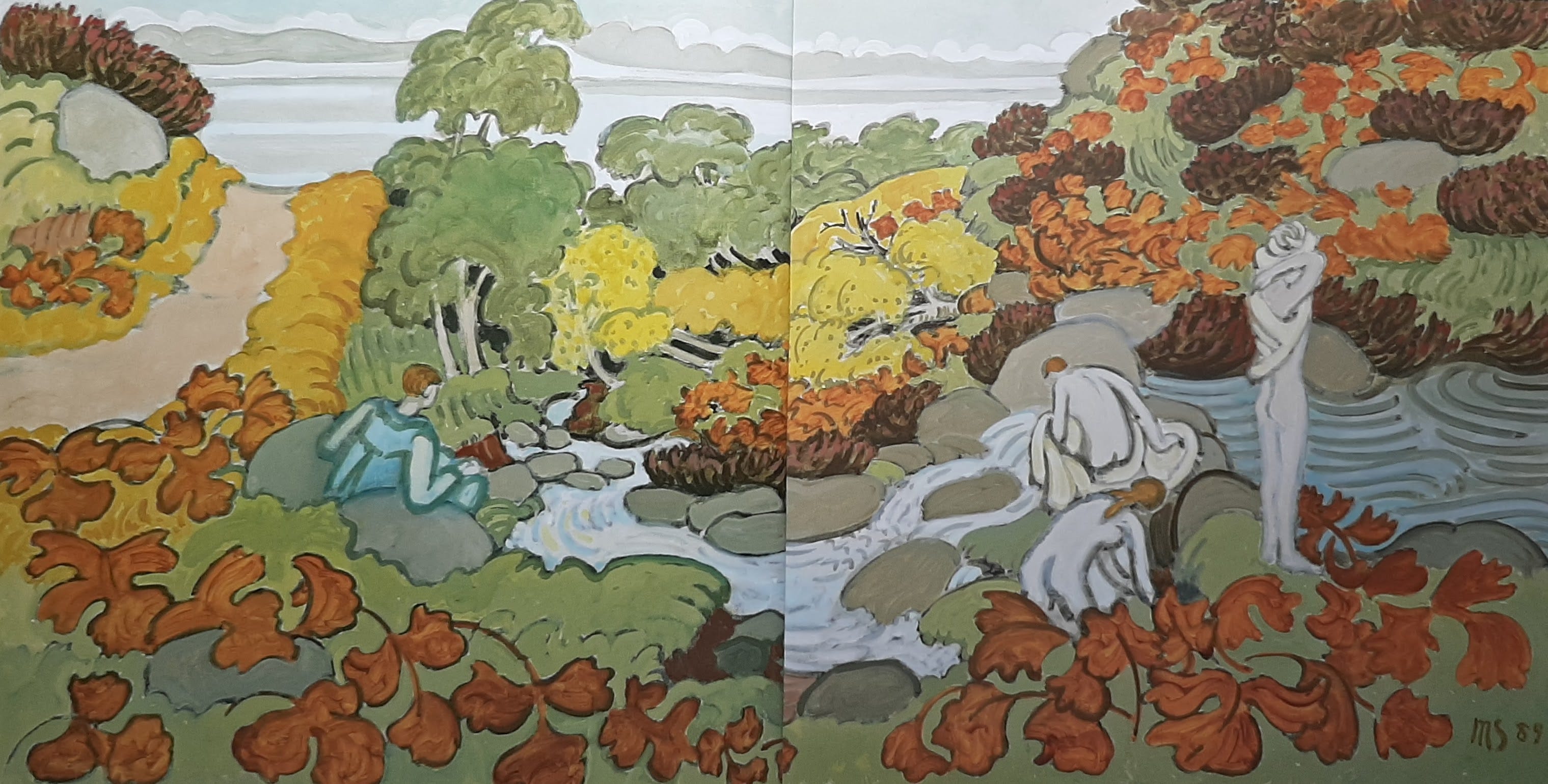
Until recently, I’ve never thought very much about what it is about certain things that I like. I couldn’t begin to understand how a novel was crafted, so I found it hard to get a grip on what the author was doing, and what I liked or disliked about their choices. I either enjoyed the book, or I didn’t but felt I should. I’m still a bit that way with drawings and paintings, even as I start to understand more about the artist’s choices. These book purchases are part of a project to find out what I like and why.
Three things I like about this painting:
The gentleness of the colours. It’s sort of respectful to the viewer’s eyes.
The curves everywhere, which should give mad movement but somehow because they’re quite careful, just give a soft stillness.
The subject! I like people; I like landscapes.
What do you like about it?
Anne Redpath
There’s a painting I love by Anne Redpath in the National Galleries in Edinburgh. It’s a still life on a table, with a rug and a chair. The perspective has been tilted to let the viewer enjoy all the items in the still life, without missing out on the pattern of the rug, which has become a backdrop. Lots of the colours are quite chalky, but there are reds and oranges in there that just glow.
Anyway, of course I bought an Anne Redpath book. I don’t think the reproduction of the still life painting does it justice, so here’s one I’ve never seen in real life:
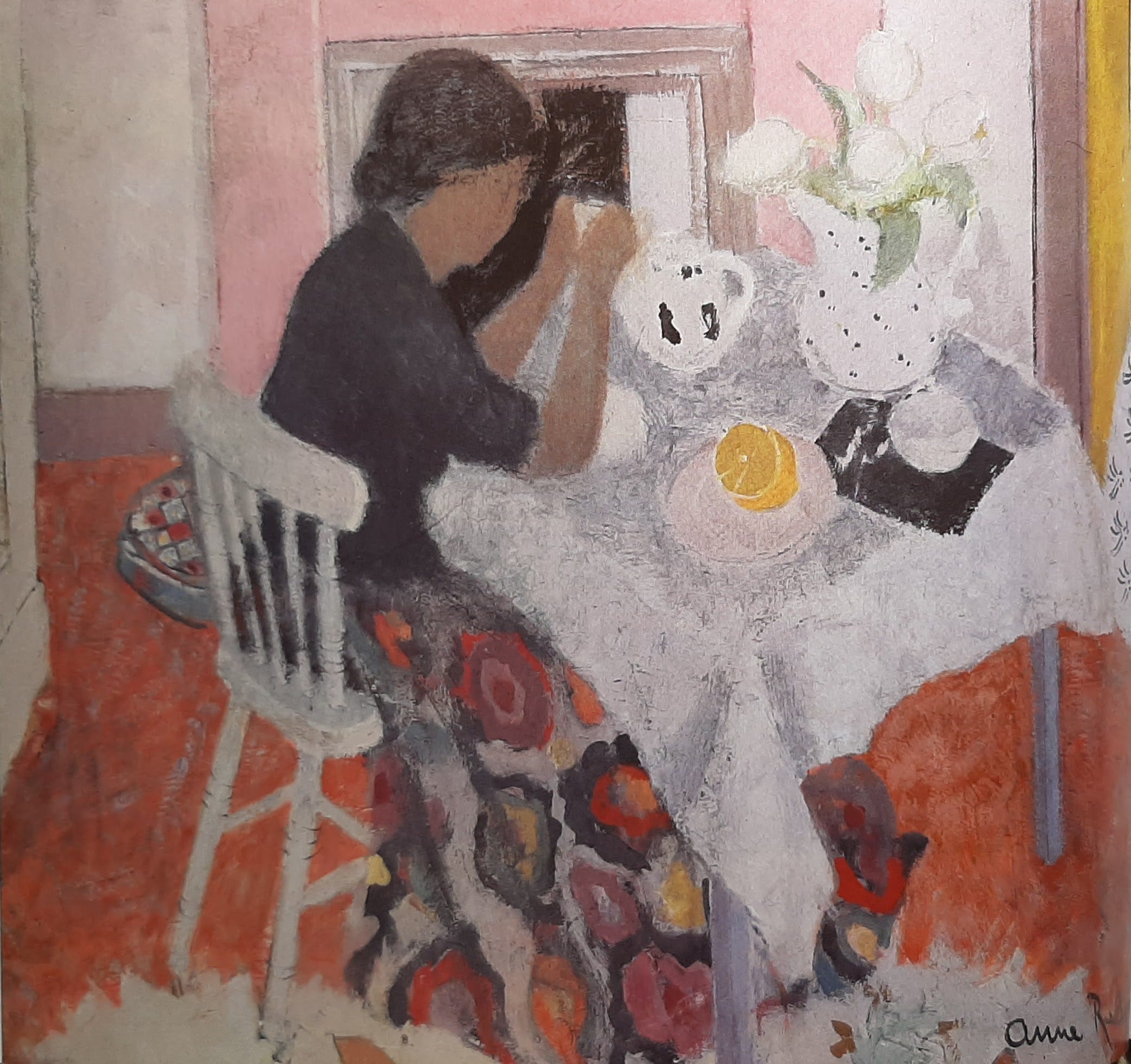
Three things I like about this painting:
The colours: warm enough to glow, muted enough to keep this scene quiet. Except for the lemon, which has clearly got something to say.
The story: I want to be the woman in the warm pretty room, and I almost can be because she doesn’t have a particular person’s face.
The lemon and the skirt. These are two things, but I read them both as being part of a generosity of the painter: she could have hidden the pattern of the skirt in realistic folds and shadow, but she’s given us all its shapes and colours. Likewise, that lemon could have been a normal size with a normal perspective, but then we wouldn’t be seeing it to its best advantage.
William Geissler
I wanted to discover more Anne Redpaths, so I looked up the other artists in the Edinburgh School. One of them was William Geissler. I couldn’t find a book about his work, but I did find a book full of it! He illustrated a whole brochure on papermaking fibres. His images show the general structure and the characteristic features of plants used for papermaking, but for some reason he’s taken it upon himself to make the images attractive and interesting too.
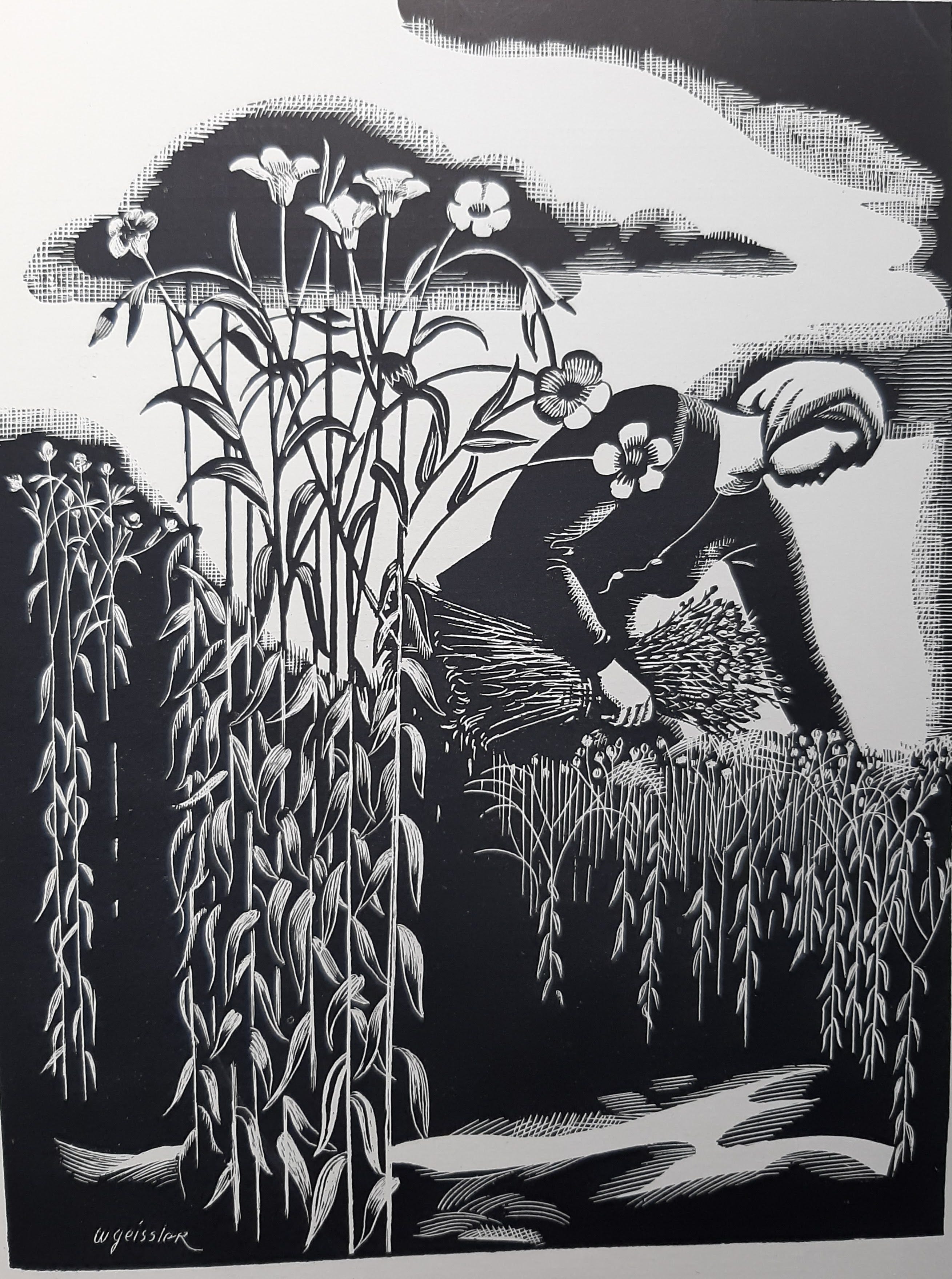
Things I like about this image:
The composition that’s more than just practical. The plant is in the foreground so that we can see its details. The cloud is behind the flowers so that they stand out, and behind the woman’s head so that her headscarf doesn’t blend into the sky. But the artist could have shown all these things without thinking about depth, or how the page was divided up.
The figure. I actually don’t really like her smooth Socialist-realist face, but I like the fact that she’s there at all.
The economy of the drawing: the delicate white stalks on that mass of black give us just enough marks for us to understand what’s being shown.
Normal Service Next Month
I hope you enjoyed these images. And I’m sorry the discussion of them was rather amateurish; I hope that if it didn’t speak to you, you just skimmed over it and will join me again next month when I’ll be back to sharing thoughts on the creative practices of drawing and writing. On the other hand, if you’d like more pictures from more books, let me know and maybe I can share them as Notes.
I loved reading this post and finding out about these artists. So interesting to read what you like about the pictures.
I enjoyed this piece. It made me think that I am more naturally reactive to, than analytical about, pictures. (If I am honest, words too.) And that, (note to self) both are necessary to improve.